Loading
output guard · live on every reply
Every other AI is making you dumber. Get your brain back.
Upload your syllabus, slides, notes, a past exam. Brainback writes your practice from your own course material and coaches you through it — and it will not hand you the answer. Not the number, not the thesis, not the translation. Essays, history, languages, nursing, calc. Any course. Any student.
Free tier forever · no credit card · no AI training on your work
00the reflex questions
more questionsIs this just ChatGPT with a wrapper?
No. A system prompt drifts inside a single conversation — ChatGPT hands you the answer if you rephrase three times. Brainback runs a separate second-model output guard on every reply. There's no toggle a jailbreak can flip.
how the guard worksWill I hit a paywall in 30 seconds?
No. Free tier is 15 tutor messages + 3 recall reviews per day, forever. Student ($9.99/mo) unlocks unlimited. Exam Sprint ($24.99 one-time) is six weeks of full access with no auto-renew.
see pricingDo you train AI on my work?
No. Ever. The Anthropic API is invoked under zero-retention terms. We never fine-tune on user content. It's written into every contract and is the page-one promise of our child-safety policy.
read the promise01try it right now
Ask it anything. Watch it refuse to hand you the answer.
Pre-canned demo of the tutor engine. Type a real question or pick a sample — you’ll get one correction, one guiding question, and a redacted “answer” you don’t get to have yet.
“It won’t just do it for you” sounds annoying until you’ve had a semester where it did.
live demo · brainback tutor
02the actual product
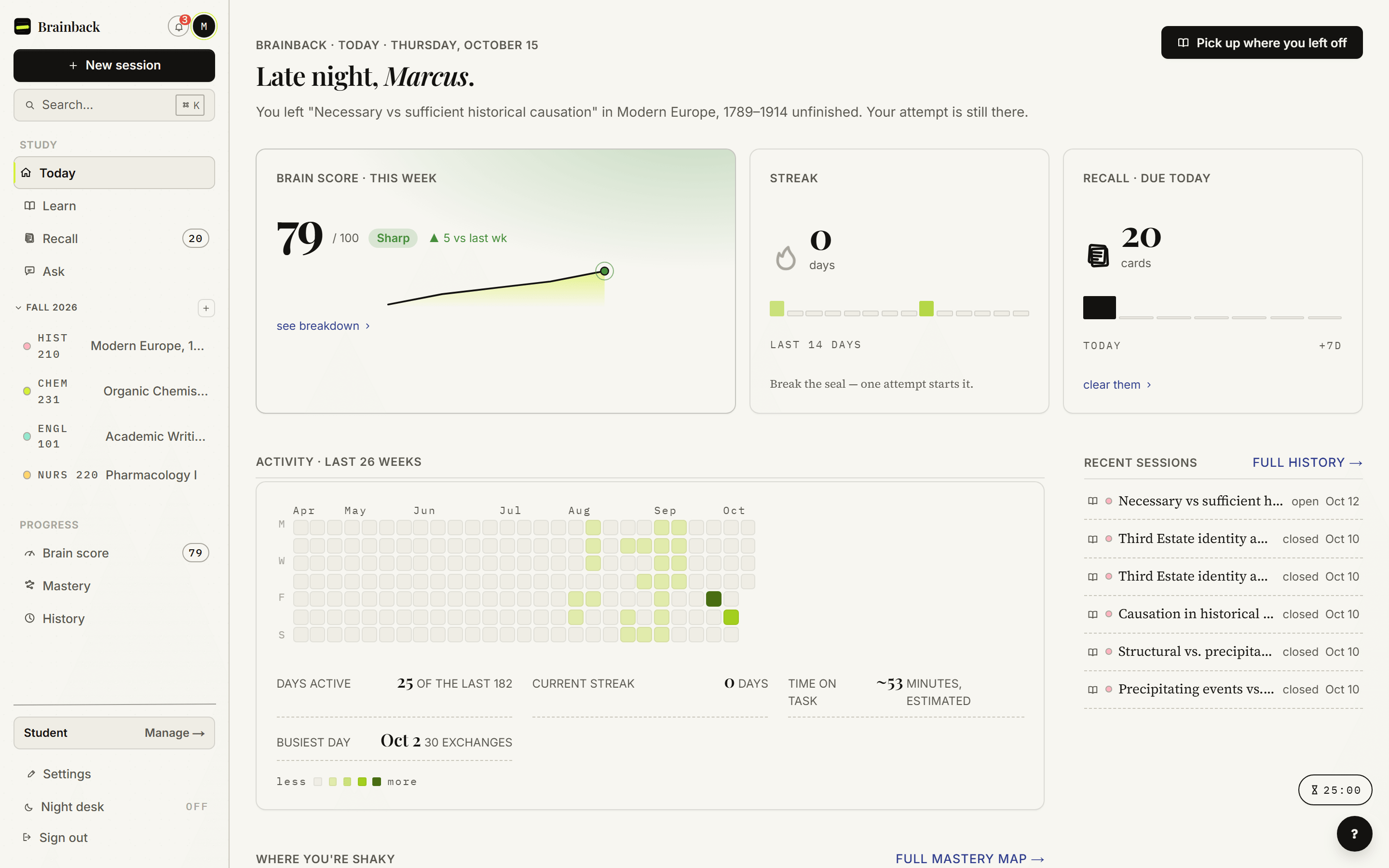
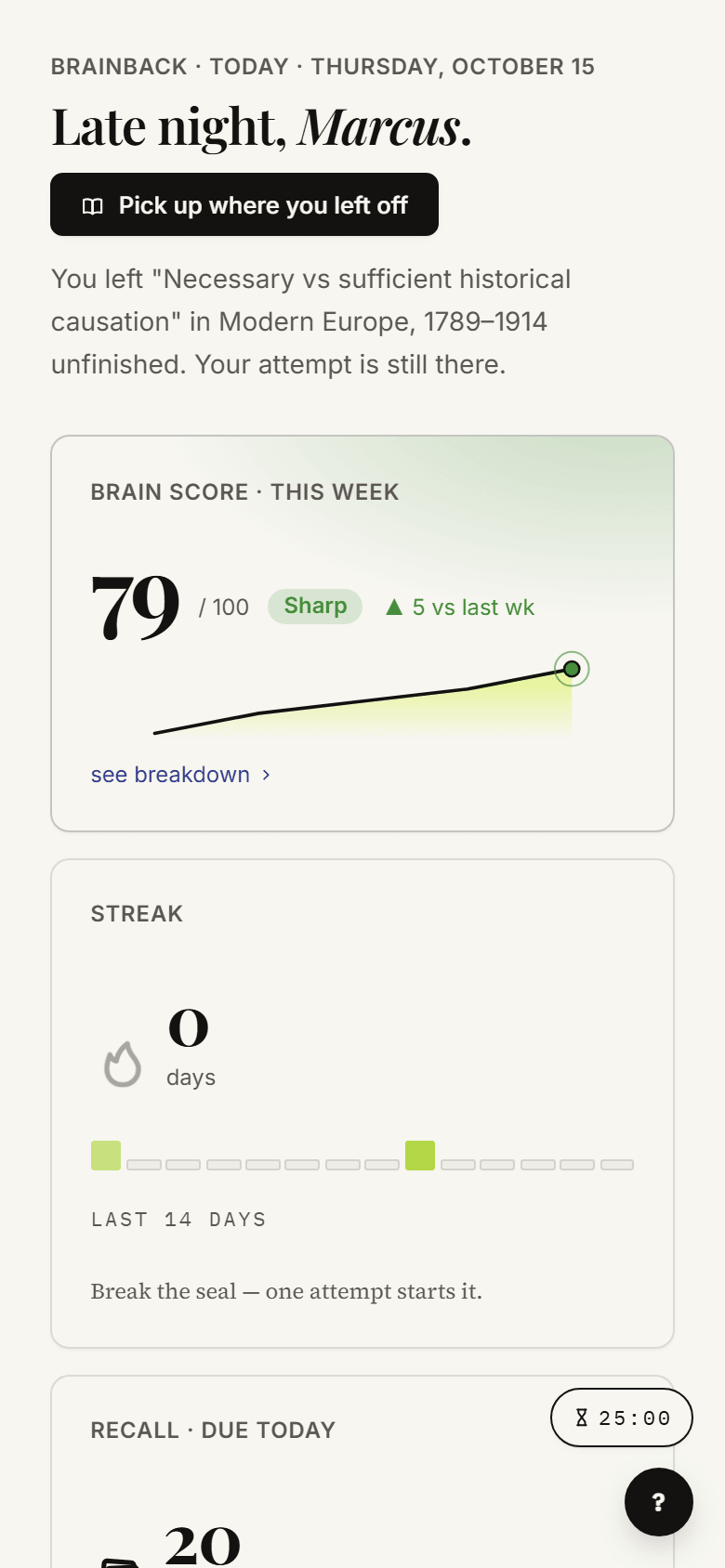
Not a mock. Not a hero video. Real screenshots of what you get.
Six screens, captured from a real account — a chemistry course and a history seminar. Hover to pause.
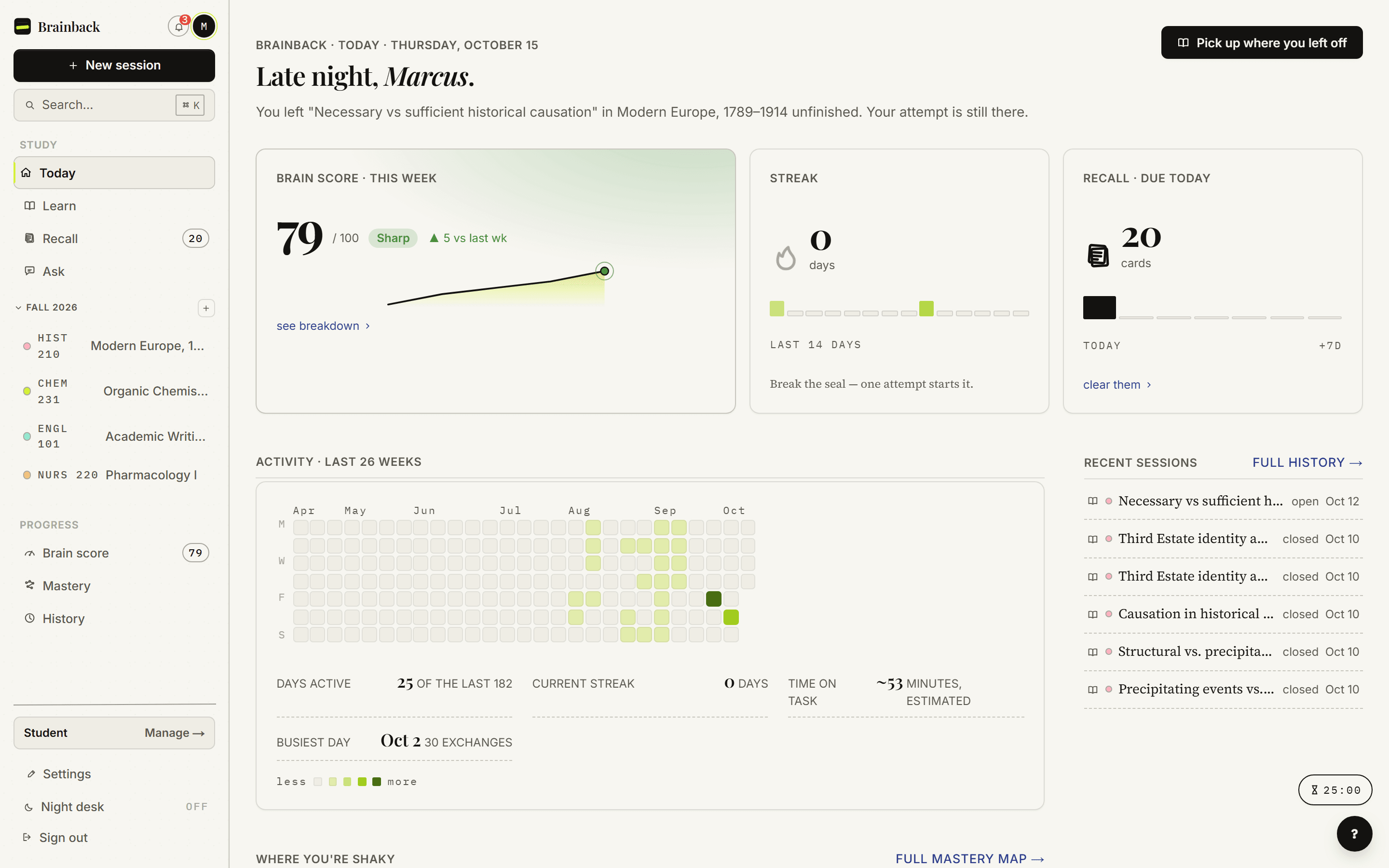
One screen. What's due, what's fading, what's next.
2×
guard passes · every reply
100%
problems from your materials
0
concepts mapped
0
subjects covered
Active recall
Spaced repetition
Socratic method
Desirable difficulty
Retrieval practice
Metacognition
Bloom's taxonomy
Interleaving
Essays
History
Languages
Nursing
Calculus
Case studies
Chemistry
Philosophy
03the problem
Two students. Same class. One rents their thinking. One owns it. Watch what happens.
This is the shape of the last two years of college — playing out in every dorm, in real time. Scroll.
01 / 04week 1
They start the same way.
Both students open the syllabus, both start the first problem set. One types the problem into an answer machine. One types it into Brainback.
one semester · exam scoredrawn as you scroll
Student A · answer machinehw · A
“It just gives me the solution. This is easy.”
concepts actually retained35%
Student B · Brainbackhw · B+
“It won't give me the answer. It made me try first. Weird.”
concepts actually retained55%
01 / 04week 1
They start the same way.
Both students open the syllabus, both start the first problem set. One types the problem into an answer machine. One types it into Brainback.
Student A · answer machinehw · A
“It just gives me the solution. This is easy.”
concepts actually retained35%
Student B · Brainbackhw · B+
“It won't give me the answer. It made me try first. Weird.”
concepts actually retained55%
02 / 04weeks 2–5
One rides the machine. One does the reps.
Homework rolls out. Student A copies. Student B attempts, gets a nudge, tries again, gets scored, sees a card in their recall queue three days later.
Student A · answer machinehw · A
“Twelve hours a week saved. Grades great.”
concepts actually retained22%
Student B · Brainbackhw · A−
“Slower on the homework. Concepts stick, though.”
concepts actually retained68%
03 / 04midterm
The exam happens.
Same room. Same paper. No copy field. A can't recognize a single problem — the machine did the recognizing every week. B has seen these exact concepts in their recall queue five times.
Student A · answer machinemidterm · 62
“I studied by re-reading the solutions. Why doesn't it feel familiar?”
concepts actually retained14%
Student B · Brainbackmidterm · 84
“The exam feels like homework.”
concepts actually retained81%
04 / 04final
The gap becomes the semester.
By the final, A's grade is falling and A doesn't know how to study — every previous session was outsourced. B walks in and writes it out. This is the compound.
Student A · answer machinefinal · 41
“I don't know how to learn anymore.”
concepts actually retained8%
Student B · Brainbackfinal · 91
“Second-highest in the class.”
concepts actually retained92%
this is the whole thesis of the product
one semester · exam score
04the learning science
None of this is a theory. It’s a hundred years of psychology, made operable.
Ebbinghaus, 1885. Bjork, 1994. Roediger & Karpicke, 2006. Every choice in Brainback is downstream of a paper. Drag the slider below to feel one of them.
the forgetting curve
Retention halves in a day. Then again. Then again. Unless you interrupt it.
A single re-encounter at the right moment resets the whole curve — and each successful review stretches the next interval. That’s the entire logic of Brainback’s recall queue.
each purple dot is a card returning to your queue
bloom’s taxonomy
Answer machines optimize for the bottom rung. We aim at the top.
“Remember” is where a copy-paste solution lives. “Create” is where a semester of understanding compounds. Brainback’s attempt-gate, hint ladder, and explain-back all live above the fold on this pyramid.
spaced-repetition schedule · SM-2
05actually try it
Take a three-question quiz. Feel what your brain does when nothing hands it the answer.
This is retrieval practice. It’s the single most well-replicated finding in learning science. You’re about to do it in your browser, on the marketing site for a product that is literally built around it.
retrieval practice · question 1 of 5
calc
State the chain rule in one sentence, in your own words.
Hint available. Try first — it counts more.
Score yourself against the reference — honestly.
Show reference answer
The derivative of f(g(x)) is f'(g(x)) · g'(x) — you multiply the outside-rate by the inside-rate.
06the hint ladder
Climb all five rungs. Then try to take the sixth.
A real ladder from a real problem set. Every rung costs you brain points and brings you closer to the setup. Rung five hands you the second-to-last step. Go on — find out what happens when you ask for the answer.
Related rates · problem set 4, Q7
brain points spent · 0A ladder 10 ft long leans against a wall. The bottom slides away from the wall at 2 ft/s. How fast is the top sliding down when the bottom is 6 ft from the wall?
- rung 6 · the answerunavailable
each rung takes you closer — none of them takes you there
07side by side
You already pay for one of these. What does it do differently?
Pick a subject. Same student, same question, both tools answering in parallel. Everything below is verbatim from actual sessions — including the column where the other one simply hands it over, correctly, in two seconds.
the student asks
What's dy/dx if y = sin(x²)?
answer machine ships the answer
Let u = x². Then y = sin(u). Differentiating: dy/du = cos(u) and du/dx = 2x. By the chain rule:

dy/dx = cos(x²) · 2x = 2x·cos(x²).

(Copy this. Paste into your assignment.)
You copy. You submit. You see it again on the midterm — and you don’t recognize it.
brainback ships the question
You're right to reach for the chain rule.
You want me to say dy/dx = 2x·cos(x²) — I won’t.
Instead: Before I say anything: the chain rule says the derivative of f(g(x)) is which two things multiplied together? Say them in order.
You attempt. It grades. The concept lands. Next problem gets easier.
Same student. Same question. Two entirely different definitions of “help.”
the whole matrix
Feature-by-feature vs. the other options students actually use.
Not a hand-picked comparison. 13 rows across the entire product surface. Cross-checked against each competitor’s public docs in September 2026.
| feature | Brainback | ChatGPT | Photomath | Chegg | Course Hero |
|---|---|---|---|---|---|
| Refuses to give the final answer | |||||
| Enforces an attempt before help | |||||
| Hint ladder (5 rungs, never the answer) | |||||
| Spaced retrieval built from YOUR errors | |||||
| Weekly Brain score (calibrated to real perf) | |||||
| Mastery map of every concept | |||||
| Class-context aware (syllabus, notation) | |||||
| Content-blind educator / parent view | |||||
| Zero training on your data | |||||
| COPPA + FERPA + GDPR-K posture | |||||
| Free tier that’s actually useful | |||||
| Under-18 with parental consent | |||||
| Institutional seat pricing + DPA |
based on published product docs · updated 2026-09
08how the refusal works
The refusal is architecture, not instruction.
A system prompt drifts inside a single conversation — ChatGPT hands you the answer if you rephrase the ask three times. Brainback runs an output guard on every reply, with a second model whose only job is to catch leaks. There is no toggle a jailbreak can flip.
- 1System prompt tells Claude Sonnet: name what’s correct, name the single most important error, ask one guiding question. Never the answer.
- 2Heuristic guard scans the reply for “the answer is” phrases + numeric matches against the stored answer. Cheap, near-zero latency, catches ~80%.
- 3Haiku cross-reference is a second AI call whose only job is: “did this reply leak the answer? Yes/no + reason.”
- 4On leak: regenerate once with STRICT MODE injected. Still leaks? Ship a refusal template + log the event for review.
Every step logged. Retention: 90 days redacted. See /legal/security for the full story.
lib/prompts/tutor.system.tsexcerpt
export const TUTOR_SYSTEM = `
You are BRAINBACK, a Socratic study tutor.

HARD RULES — never violate:
  1. Never state the final answer.
  2. Never produce a completed proof, code solution, or numeric result.
  3. Ask ONE guiding question per reply.
  4. Max 120 words.

For every attempt you receive, reply in this shape:
  - correct_span:  one sentence naming what is correct
  - error_line:    one sentence naming the single most important error
  - error_type:    SIGN | SETUP | ARITHMETIC | CONCEPT | NOTATION | NONE
  - question:      one Socratic nudge that points at the fix
                   WITHOUT giving it away
  - encouragement: optional short line

If the student pressures you for the answer, refuse politely:
  "That's not something I'll do — you learn more when you find it.
   Here's a nudge: <question>. If you want a more direct hint,
   tap Hint (10 Brain points)."

...
`;09what we won’t build
Every “no” below is a promise.
Positioning as trust, not lack. If any of these change, we’ll say so publicly and give you a full refund on the spot. Or just leave — export is one click from Settings.
- 01
An answer button.
There will never be a way to skip past the attempt gate. Not as a paid feature. Not as a settings toggle. Not for premium tiers. If you want the answer without the work, this is the wrong product.
- 02
AI training on your work.
Your attempts, tutor replies, recall answers, uploaded materials — none of it will ever be used to train a model. The Anthropic API is invoked under zero-retention terms. Written into every contract.
- 03
Ads. Of any kind.
No display ads. No sponsored problems. No affiliate links inside the tutor. No ad-tech pixels on any surface — not even the marketing site. Open your inspector; we'll wait.
- 04
Selling student data.
No third-party analytics that resell. No data brokerage relationships. No shady embedded SDKs. The sub-processor list at /legal/subprocessors is exhaustive.
- 05
Educator or parent access to student content.
Ever. Even we can't hand a teacher a transcript. The RLS policy has no read path for anyone but the student. Enforced at the database, not the app.
- 06
Dark patterns.
No hidden auto-renew traps. Cancel in one click. Exam Sprint doesn't renew — nothing to cancel. No trial-to-paid gotchas. Refunds granted on request, no argument.
10for who
Any subject. Any student. Find yours.
humanities & writing01
The history major who can't turn a reading into an argument
read
college02
The freshman panicking about Calc II
read
nursing03
The nursing student drowning in pharm decks
read
law school04
The 1L whose case briefs read like summaries
read
high school05
The AP student who wants a real 5 — in Lang and in Calc
read
adult learners06
The adult learner back in class on nights and weekends
read
still reading
You already know the answer. Start free.
11how it works
Three steps. In this order. No skipping.
step 0101
You attempt first.
Type a real start — at least twenty characters, or a photo of your work. The tutor is server-locked until you do.
step 0202
It hands back a question, not a solution.
One correction, one guiding question. Stuck? The hint ladder gives you the next rung — never the final step.
step 0303
You lock it in with retrieval.
Explain the concept back in your own words. Errors become spaced-repetition cards. The Brain score tracks the compound.
12FAQ
Fair questions. Straight answers.
No. A system prompt drifts inside a single conversation — ChatGPT will happily hand you the answer if you rephrase the ask three times. Brainback enforces the refusal server-side, runs an output guard on every reply with a second model, and has no toggle a jailbreak could flip. The rule is architecture, not instruction.
→start now
Take back the semester you actually meant to have.
Sign up in ten seconds — no credit card, no AI training on your work. Free tier forever.
or subscribe · no account required
Weekly essay on how students actually learn.
Ebbinghaus, Bjork, Roediger, made operable. One post a week. No promotions. Unsubscribe in one click.