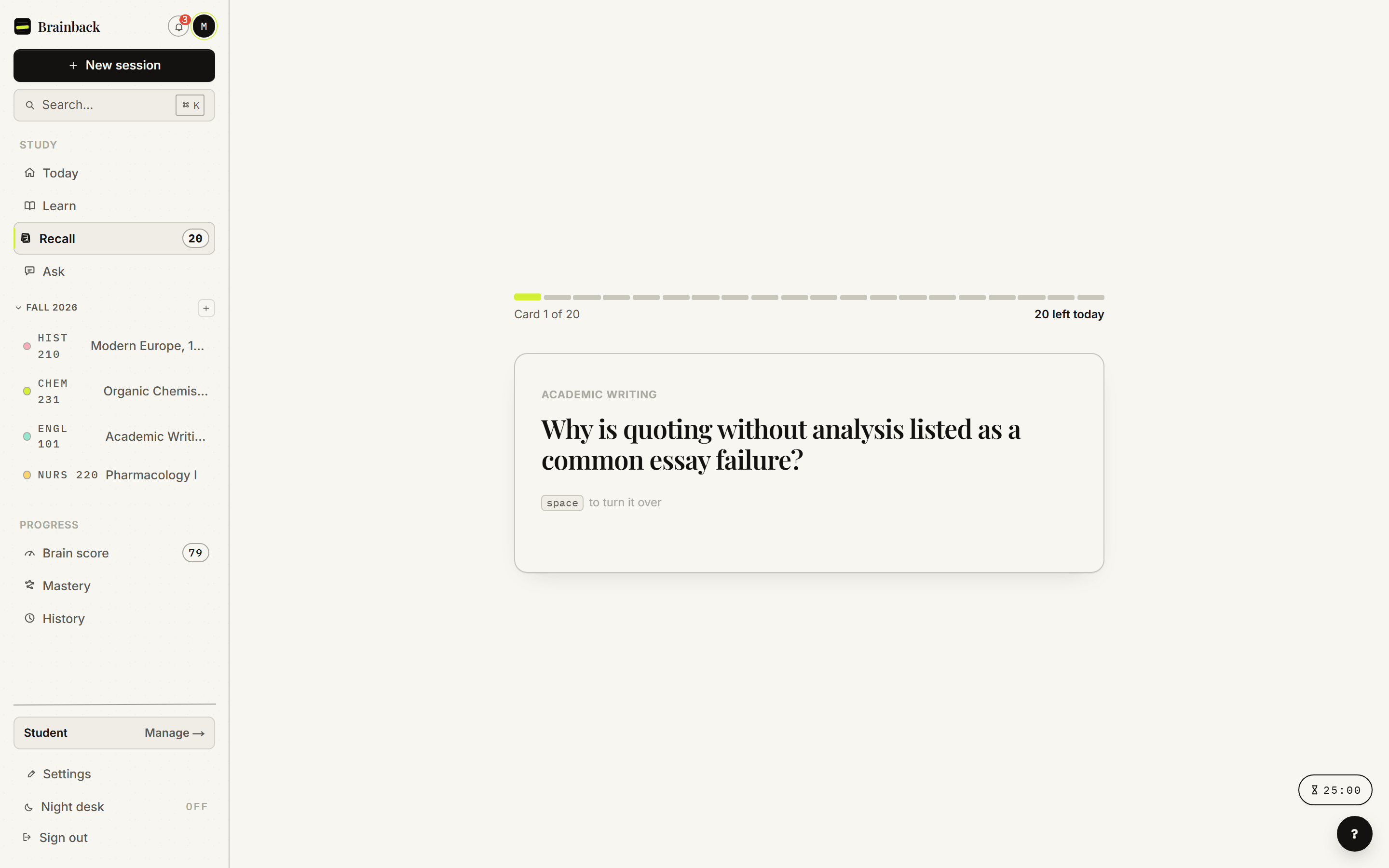
Pre-made flashcard decks optimize for the average learner’s gaps. Yours are not average — they are yours. A card that tests knowledge you already have is a card that wastes your time. A card that skips knowledge you don’t have is a card that reinforces a hidden gap.
Brainback cards are generated from problems you got wrong and concepts you explained back poorly. They are rephrased by Haiku so you can’t rely on surface recognition — but the underlying concept is one you actually failed to demonstrate. Every review is a test of a gap you actually have.
SM-2, in plain English
SM-2 is a scheduling algorithm from 1990. It works. Every recall product worth using descends from it. Here’s how it applies inside Brainback:
- New card: reviewed the next day.
- Rated Good or better: next interval = previous × ease factor. Ease starts at 2.5.
- Rated Again: ease drops by 0.20, interval resets to 1 day.
- Rated Easy: ease climbs, interval multiplies by a larger factor.
Over weeks, cards you know well drift to longer intervals. Cards you struggle with come back often. The math does the tuning; you don’t.
The review UX
Cards flip on tap or spacebar. Before flipping, you’re asked for your confidence — one to five. That data feeds calibration. After flipping, four buttons: Again, Hard, Good, Easy. Any more granularity and users froze; any less and the scheduling got noisy.
The whole review is designed for one thing: speed. Median time to review a card in Brainback is nine seconds. You’ll do ten cards in less time than it takes to make coffee.
The offline story
The PWA caches your entire due queue on the last online visit. You can complete an entire review session on the subway. When you re-connect, grades sync back and the schedule updates. Because SM-2 is deterministic and the client can compute the next-due date locally, there’s no server round-trip during a review — the entire experience is native-app fast.