Loading
product
Every surface, in the order it fires.
Brainback is a deliberately small set of features chained into a single workflow. Nothing is here for decoration. Every piece exists because a specific failure mode of AI-assisted study demanded it.
seven surfacesengine · not a feature list
7
Surfaces in the engine
Each one has a dedicated page. No feature sits undocumented.
0
Answer buttons
There is no toggle inside the app that flips the tutor to answer mode.
40 / 30 / 30
Brain score weights
Recall accuracy · calibration · explain-back quality.
what it looks like
Everything below is on this screen.
A real capture, not a mock — taken from production by the same script that keeps every screenshot on this site current. The three arrows are the three surfaces this page documents.
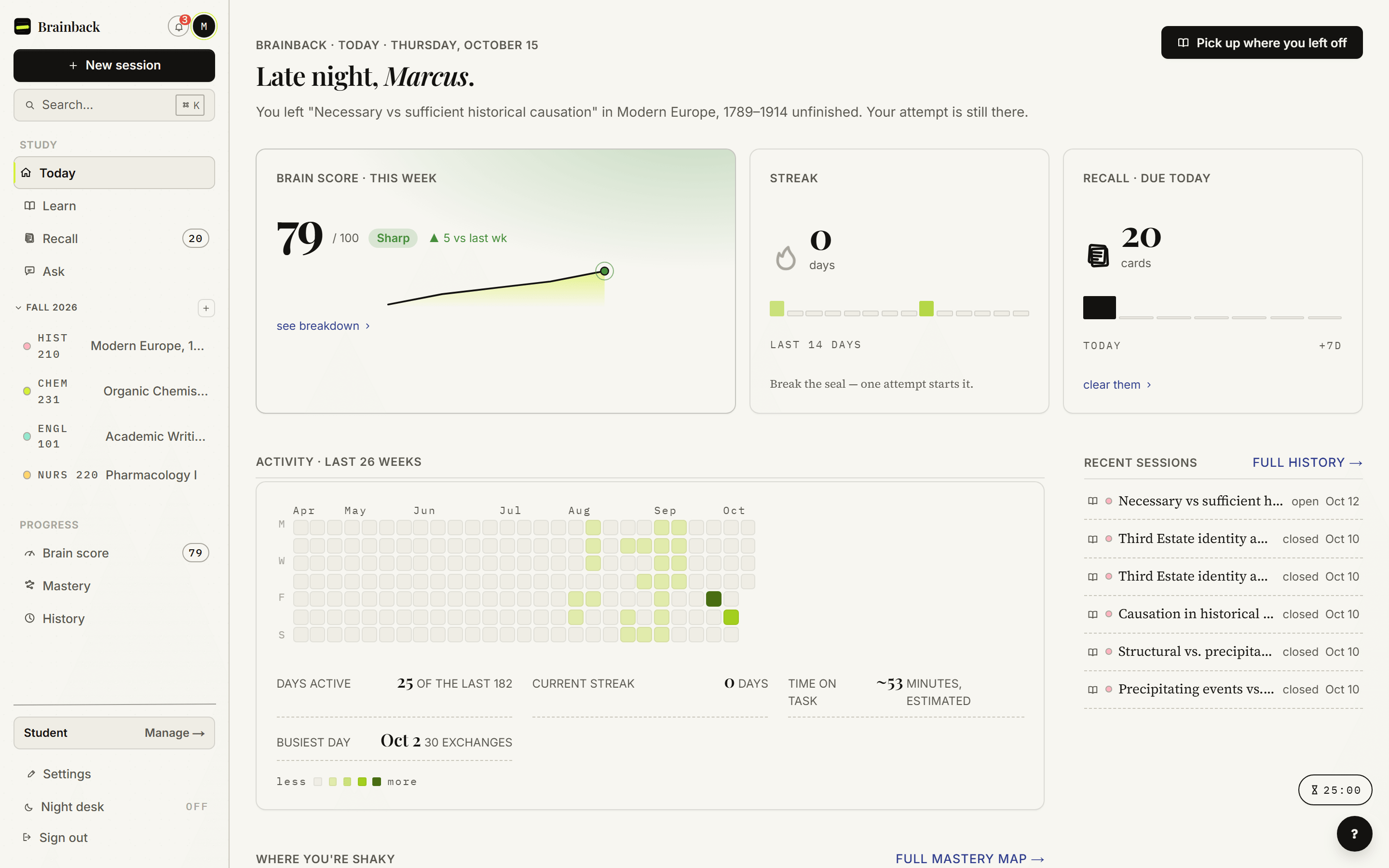
- 1The Brain score: one number a week, from recall accuracy, calibration and explain-back.
- 2Twenty-six weeks of days you actually showed up. The streak is a consequence, not a mechanic.
- 3Every session kept, with what it cost you in hints.
the chain
The whole engine, in the order it fires during a real study session.
You start with a problem. You end with a card in your recall queue and a small delta on your Brain score. Everything in between happens in this order, on purpose, every time.
Learn mode
The Socratic tutor. Attempt first, guided second, answered never.
Every academic conversation on Brainback runs inside Learn mode. The system prompt is versioned, cached, and enforced server-side. It refuses to output final answers. It refuses to work the problem for you. It hands back a question, one correction, and the next hint you've earned.
Read learn modeHint ladder
Five calibrated rungs. None to the answer. The final step is always yours.
Concept, then tool, then setup, then first step, then second-to-last. That's the ladder. Level 6 doesn't exist. Every hint costs points. A hint that costs nothing becomes an answer button — which is exactly what we refuse to be.
Read hint ladderExplain-back
Teach it back in your own words. Haiku scores 0–5 with actionable feedback.
Getting the answer is the easy half. The hard half is being able to reconstruct the reasoning from scratch a week later. Explain-back forces the reconstruction on the day it counts most — right after you got the concept — so the memory encodes deep.
Read explain-backSpaced recall
SM-2 scheduling. Cards generated automatically from every wrong attempt.
You never write your own flashcards. Every misstep in a Learn session becomes a card, tied to the concept it revealed. The queue expands and contracts by the SM-2 algorithm — one of the most-replicated findings in learning science, made operable.
Read spaced recallBrain score
One weekly number. Recall accuracy, confidence calibration, explain-back quality.
40% recall accuracy, 30% calibration, 30% explain-back. The score is a compass, not a leaderboard. It moves slowly. It resists gaming. It tells you whether the semester is compounding — or leaking.
Read brain scoreEfficiency mode
Normal AI for everything not in your declared subjects. Full streaming, full completion.
Rewriting your résumé, brainstorming a talk, coding a scratch script for a project outside your major — Efficiency mode handles those the way any other assistant does. Learn mode never gets crossed with it, and the tutor never leaks a solution through the efficiency lane.
Read efficiency modeOutput guard
Every reply passes a second-model check before it reaches you. No leaks. On purpose.
A single system prompt is easy to jailbreak; a separate second-model output guard is not. Every tutor reply is re-read by Claude Haiku with one job — was this a covert answer? — and regenerated or refused if it was. The guarantee is architectural, not textual.
Read output guard
skim view
Same seven, tiled.
For prospects who read documentation right-to-left. Every tile is a full page underneath.
01 · the container
Learn mode
The Socratic tutor. Attempt first, guided second, answered never.
read
02 · the scaffold
Hint ladder
Five calibrated rungs. None to the answer. The final step is always yours.
read
03 · the seal
Explain-back
Teach it back in your own words. Haiku scores 0–5 with actionable feedback.
read
04 · the memory
Spaced recall
SM-2 scheduling. Cards generated automatically from every wrong attempt.
read
05 · the compass
Brain score
One weekly number. Recall accuracy, confidence calibration, explain-back quality.
read
06 · the lane
Efficiency mode
Normal AI for everything not in your declared subjects. Full streaming, full completion.
read
07 · the promise
Output guard
Every reply passes a second-model check before it reaches you. No leaks. On purpose.
read
every behavior, both sides
What the engine changes about the way you study.
Eight moments during a normal study session. For each, what Brainback does — and what an answer machine does instead.
| behavior | with brainback | answer machines |
|---|---|---|
| Answer question | Refused. A guiding question is returned instead. | Complete solution, on demand. |
| First move on a new problem | Attempt gate: minimum 20 chars or a photo of your work. | None. Enter and receive. |
| Stuck | One hint per press. Never the answer. Costs points. | Complete walkthrough on request. |
| After you get it | Explain-back. Haiku grades 0–5 with feedback. | None. You never confirm you learned it. |
| Mistake made yesterday | SM-2 card, generated automatically, in your queue. | Gone until the exam. |
| Progress signal | Brain score, weekly. 40/30/30, decomposed by subject. | Grades. Which lag learning by weeks. |
| Non-coursework tasks | Efficiency mode. Full completion, no guardrails. | Same tool, no separation. |
| Jailbreak of the tutor | Sanitized input + Haiku output guard on every reply. | Rephrase three times, get the answer. |
the “without” column is the entire pitch of every other AI study product
how we chose what to build
Four constraints. Every feature clears all four, or it doesn’t ship.
1 · Refuses to short-circuit reasoning.
If a feature could let a user skip the productive struggle — get the answer without the attempt, get the concept without the recall — it doesn't ship.
2 · Works with your existing coursework.
You should not have to migrate anything. Paste from any textbook, snap any homework page, connect any class syllabus. Brainback fits around the semester you already have.
3 · Doesn't leak on jailbreak.
Every safety property is enforced server-side, with a separate model checking the tutor's output. A single system prompt is not a control.
4 · Compounds over time.
Every session must leave a durable trace — a card, a score delta, a mastery marker — that pays back on the exam six weeks from now, not just today.
under the hood
Tutor: Claude Sonnet 5 (Haiku 4.5 in light mode). Grader + guard: Claude Haiku 4.5. Training: none — Anthropic doesn’t train on API traffic, and we don’t train on your work. We hold no zero-retention agreement, so limited trust-and-safety retention applies on their side. Prompts: versioned, cached via cache_control: ephemeral. Rate limits: Upstash Redis, per-user token bucket. Auth: Supabase, RLS on every user-owned table.
fair questions
Straight answers.
Do I need to use every feature?▾
No. The minimum viable loop is Learn mode → attempt → hint → explain-back. Spaced recall builds itself in the background. The Brain score computes weekly whether you look at it or not. Efficiency mode and the output guard are always on. Nothing you can turn off will make the tutor answer the question.
Which features are behind a paywall?▾
Free forever: Learn mode, hint ladder up to level 5, three recall reviews a day, the weekly Brain score, and the output guard. Student ($9.99/mo) unlocks unlimited tutor turns, unlimited recall, Efficiency mode, and shareable OG cards. See pricing.
How does the tutor know it's my class?▾
You declare your subjects in Settings. Anything you add there is treated as academic and routed through Learn mode. Everything else falls to Efficiency mode. You can attach class materials (syllabi, PDFs, notes) to give the tutor context on what your professor emphasizes; it uses those but does not leak them.
What's under the hood?▾
Anthropic Claude Sonnet 5 is the tutor, dropping to Claude Haiku 4.5 once a day’s usage passes a cost threshold (you are told when that happens). Haiku also grades explain-backs and runs the output guard. Neither Anthropic nor we train anything on your work. See the security page for what that does and does not cover.
Can I use it on iPad / mobile?▾
Yes. The web app is a full PWA — installable, offline-capable for recall reviews, and hardware-keyboard friendly. Native iOS and Android apps are on the roadmap, but the current web app on iPad is already the primary surface for a big fraction of users.
→the whole engine
Free forever, on every surface.
Sign up and every one of the seven pieces is on your dashboard in ten seconds. No credit card. No trial clock.